Leave Your Message
Choosing Cardboard Lipstick Tubes is not just a question of replacing plastic with paper. The tube must protect the lipstick, feel comfortable in the hand, and fit the way customers use it. A sample may look elegant on a desk but feel loose after repeated twisting. Small details matter. Before comparing finishes or prices, define the lipstick’s dimensions, weight, and mechanism. Ask suppliers how the inner structure supports the formula and how the cap stays secure during transport. Then test a filled tube, not just an empty sample. A few twists can reveal wobble, scraping, or a cap that does not close cleanly.
Material and decoration choices affect both appearance and performance. Paperboard thickness, surface coating, and printing can change how a tube feels and holds up to handling. A matte finish may show fingerprints differently from a glossy one; neither is automatically the better choice. Request written specifications, production samples, and clear details about minimum order quantities and lead times. If recyclability is part of your brand message, verify the complete packaging construction and disposal guidance rather than relying on a paper-like exterior. There is no perfect option for every brand. Sometimes the most attractive sample is not the most practical one, and that is worth admitting. Compare options against your product, budget, and customer expectations, then run a small usability check before approving a larger order. The right choice should work on the shelf and in daily use.
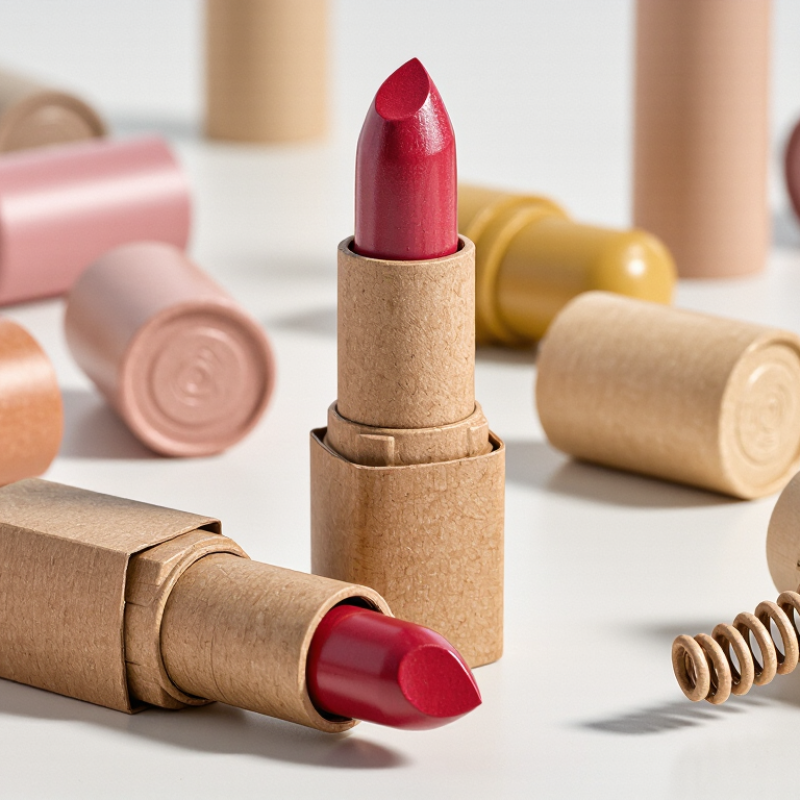
Before choosing cardboard lipstick tubes, define what the package must do. Measure the assembled lipstick, including its cap, and note its weight and shape. The tube should fit snugly without crushing the carton or rattling during transport. Check how the cardboard sleeve works with the lipstick’s inner component; the formula should remain protected by suitable primary packaging. Consider where customers will store it, too. A slim tube may look elegant, but it can be harder to grip with wet hands.
Tips: Request a physical sample. Open and close it repeatedly, then check for loose caps, scuffed edges, and difficult removal. Test it in a handbag or shipping box.
Next, set priorities for appearance and production. Choose a surface finish that suits your design, such as a smooth matte coating or visible paper texture. Ask suppliers for material details and evidence behind any recyclability or recycled-content claims. Printing can look different on uncoated board, so review a real sample under ordinary indoor light. Be honest about trade-offs: thicker board may feel sturdy, but it can add bulk and cost. Your first specification may miss something. Revise it after handling samples and getting feedback from people who will use the package.
| Requirement | Options or planning data | What to consider | Specification to confirm |
|---|---|---|---|
| Product format | Conventional lipstick, lip balm, or another solid lip product | Formula shape, firmness, and dispensing method determine the inner holder and mechanism. A paper outer shell alone does not establish product compatibility. | Provide the product format, formula constraints, and the intended dispensing mechanism to the packaging supplier. |
| Fill weight and product size | Specify the target net fill weight in grams and the product’s measured diameter and height. These values vary by product and container design. | Net weight does not directly determine tube dimensions; product density, bullet shape, and the mechanism also affect fit. | Confirm internal clearance, usable product height, and final dimensions using a production-representative sample. |
| Tube dimensions | Set the overall height and outside diameter from the product, mechanism, and desired hand feel; there is no single standard size for all cardboard lipstick tubes. | Allow room for the inner component, cap, and any movement needed for opening and closing. | Record external dimensions, internal fit, cap depth, and dimensional tolerances on the approved drawing. |
| Structure and materials | Paperboard or wound-paper body with a compatible inner holder, base, and cap or closure | Paper grades and component combinations affect stiffness, surface quality, weight, and end-of-life separation. | Request material composition and a component-level description, including any plastic, metal, adhesive, or coating. |
| Closure and mechanism | Choose a cap and dispensing mechanism designed for the selected product and tube structure. | Check cap retention, smooth operation, product retraction, and whether the package stays closed during handling. | Test assembled samples through repeated opening and closing and check for loosening, jamming, or product contact issues. |
| Product protection | Assess contact materials, fit, closure, and protection from handling, light, moisture, and contamination as relevant to the formula. | Paperboard is not automatically a moisture barrier or a suitable direct-contact material. Suitability depends on the complete package construction. | Confirm material compatibility and any required barrier or inner component with the supplier and the product safety team. |
| Decoration and finish | Printed graphics, labels, embossing, debossing, or surface coatings, subject to the selected board and manufacturing process | Finishes can affect appearance, scuff resistance, cost, and recyclability. Fine details may need a physical proof. | Approve artwork, color references, print placement, and a finished sample before production. |
| Sustainability requirements | Define recycled-content targets, preferred fiber sourcing, and packaging end-of-life goals where applicable. | Recyclability depends on the full package, including coatings, adhesives, and non-paper parts, as well as local collection and recycling systems. | Request material documentation and assess the assembled package against the markets where it will be sold. |
| Production and logistics | Set order quantity, delivery schedule, packing format, and shipping conditions before finalizing the specification. | Structure, decoration, and order quantity can affect production feasibility, lead time, and transit protection. | Confirm minimum order quantity, tolerances, quality checks, carton configuration, and sample approval process. |
| Planning note: Values and configurations should be finalized with measured product samples and supplier drawings. Test the complete, assembled package with the intended formula before approving production. | |||